




































































I don’t think anyone could’ve predicted the impact the Twilight series had on young adults across the globe. Before the novel was published, supernatural romances weren’t unpopular, with TV shows like The Vampire Diaries and Buffy the Vampire Slayer setting the tone for the genre. However, in 2005, author Stephenie Meyer released Twilight, which changed the world– for better or for worse. Set in the stormy town of Forks, Washington, the Twilight saga is a series of books and films released in the late 2000’s. It follows the life of Bella Swan as she navigates a bizarre love triangle between vampire Edward Cullen and werewolf Jacob Black. There’s no doubt Twilight has changed the romance genre, but whether it’s truly as good as it seems is up for debate.
If it weren’t for a dream, Twilight wouldn’t be. Meyer recalls a vivid dream she had in 2003, describing a vampire in love with a young girl who thirsted for her blood. This one dream inspired her to write the first draft of Twilight in only three months. Unfortunately, the novel was shunned by most publishers, but was accepted after trial and error. In 2005, Twilight was published under Little, Brown and Company with a print run of 75,000 copies. Immediately, it was a hit, peaking at number one on the New York Times bestseller list. A year after Twilight was published, Meyer wrote the sequel novel New Moon, focusing on the brewing relationship between Jacob and Bella. Subsequently, Eclipse was published in 2008, and Breaking Dawn was released shortly after. Saying Twilight changed the landscape of literature is an understatement– it was edgy, dark, and totally idealistic. The series was an absolute gold mine to young readers worldwide, putting them in a world bordering on the edge of reality and fantasy.
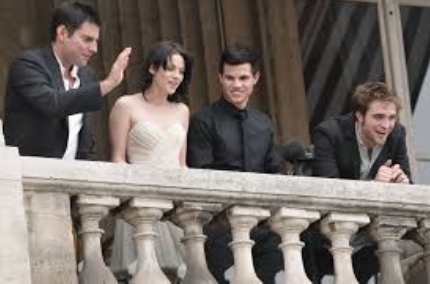
After the initial success of the first novel, Summit Entertainment began adapting the book into a film. In 2008, the first Twilight film was released alongside a star-studded cast, including Kristen Stewart as Bella, Robert Pattinson as Edward, and Taylor Lautner as Jacob. The movie made a staggering 407 million dollars worldwide, with the film having one of the highest-grossing opening weekends that year. In terms of an adaptation, the Twilight film was significantly close to the novel. The movie’s soundtrack reflects Meyer’s own musical taste, with “Decode” by Paramore and “15 Step” by Radiohead being featured in the movie. Notably, “Supermassive Black Hole” by Muse was used in the infamous baseball scene. Because of the film’s success, Summit Entertainment continued producing adaptations of the series. Following the original Twilight film came four sequels– New Moon in 2009, Eclipse in 2010, Breaking Dawn: Part 1 in 2011, and Breaking Dawn: Part 2 in 2012. These movies had a massive impact on the series, boosting Meyer’s vision further and further into the mainstream. It was hard not to hear anyone talking about “Team Edward” or “Team Jacob” at the time.
While it’s all good to reflect fondly on the story, it’s important to recognize the faults within the series. One of the deepest controversies surrounding Twilight is the inaccurate and ignorant depiction of indigenous tribes. The Quilete tribe of La Push, Washington, challenged Meyer due to the theft of culture and the dehumanization of indigenous people. Being a member of the Quilete tribe, Jacob Black’s characterization by Meyer caused the people to be represented as mythical creatures instead of human beings. These harmful characterizations that revolve around the tribe continue to haunt the series and the rest of her work. Another nail in the coffin involves the romanticization of abuse within Bella and Edward’s relationship. The idea behind Edward is that he is a protective and brooding man, but still cares for Bella despite his bloodlust. In concept, this is a fantastic trope within literature, but with Meyer’s characterization, it comes off as manipulative and controlling. Edward frequently gaslights Bella into doubting her own reality, watches her sleep, and intimidates her through his extreme physical advantage. Considering the demographic for the series, Meyer’s depiction of Edward is incredibly harmful. It sets an example of what is seen as “attractive” within a relationship, especially among young women. These inaccurate portrayals of relationships can really leave a mark on beauty and relationship standards, ultimately romanticizing unwanted behavior and mistreatment– even outside the series.