








































































Since 1947, Israel and Palestine have been in constant conflict. May 19, 1948, seemed to be a starting point for these issues when Israel claimed independence. Israel’s independence led to war with neighboring Arab-states, including Palestine. Israel won the war and expanded its territory. In 1964, the Palestinian Liberation Organization was founded to “represent visions of destruction of Israel, self-determination and a state” (ajc.org). Another war took place in 1967 between Israel and multiple Arab-states that lasted 6 days. Israel won that war as well and captured many territories, including East Jerusalem plus the West Bank, and the Gaza Strip. This war led to a rise in Palestinian nationalism and Arab-states’ rejection of Israel. In 1972, the “Munich Olympics Massacre” was Palestine’s first major terrorist attack on Israel. The terrorists held 11 members of the Israeli Olympic team hostage and later murdered them. After the Lebanon war in 1982, the first intifada followed in 1987. Frustrations from “Israel’s control of the West Bank and Gaza Strip, economic hardships, and a lack of political progress toward a Palestinian state”(.ajc.org) boiled up into violent civil rights protests. A terrorist group called Hamas was created as a result. A peace conference was attempted in 1991, but it didn’t do much as the second intifada took place in 2000. This intifada was much more intense than the last, including violent attacks and confrontations. The second intifada led to the construction of the West Bank barrier by Israel. Israel eventually dismantled its settlements and military installations as it withdrew from Gaza in 2005. After the withdrawal, the Iran-backed Hamas terrorist group took control of Gaza in 2007. Conflicts have gone back and forth between Israel and Palestine over the years.
The most recent war essentially sparked when Hamas launched a surprise attack on multiple Israeli communities in 2023. This attack left 1,200 dead and 40 Israeli hostages. Israel officially declared war against Hamas and imposed a complete siege of Gaza, leaving a million Palestinians to evacuate North Gaza. Israel and Palestine came to a temporary truce lasting from November 24th to December 30th, and after lots of criticism from other countries, Israel “shifts to lower intensity operations in Gaza” (ajc.org). In the fall of that year, the IDF launched a renewed offensive around the Jabalia refugee camp to eliminate remaining Hamas militants. Israel advanced for a “total siege” of that area and withheld humanitarian aid in the process of trying to force the surrender of Hamas militants. From October 6th to December 31st, the UN has tried reaching the besieged area of Gaza a total of 165 times; Israel denied 149 of those attempts. Those blocked attempts have left the people of Gaza and other Palestinians hungry, hurt, and in desperate need of help
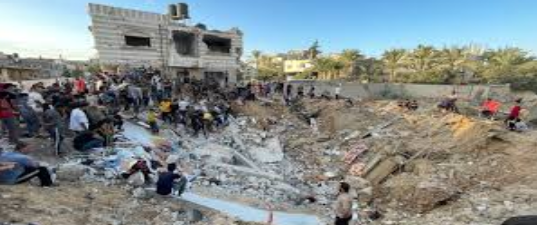
This ongoing war has had devastating impacts on Gaza. As of January 2025, 1.9 million Gazans have been displaced, and the food insecurities are catastrophic. There are currently no functioning hospitals in Gaza, a reported 46,000 deaths, and a total of 17,000 Hamas militants still occupying the area. Along with the hospitals, almost all the schools are either damaged or destroyed. “The war will set education back there by up to 5 years” (theguardian.com). Not only are Gazans’ education and healthcare systems impacted negatively, but also their ecosystem and biodiversity. Soil and water in Gaza are contaminated, causing damage to the land, and a great number of trees are being destroyed. All of which will leave long-term impacts that could take years to even start repairing.