

































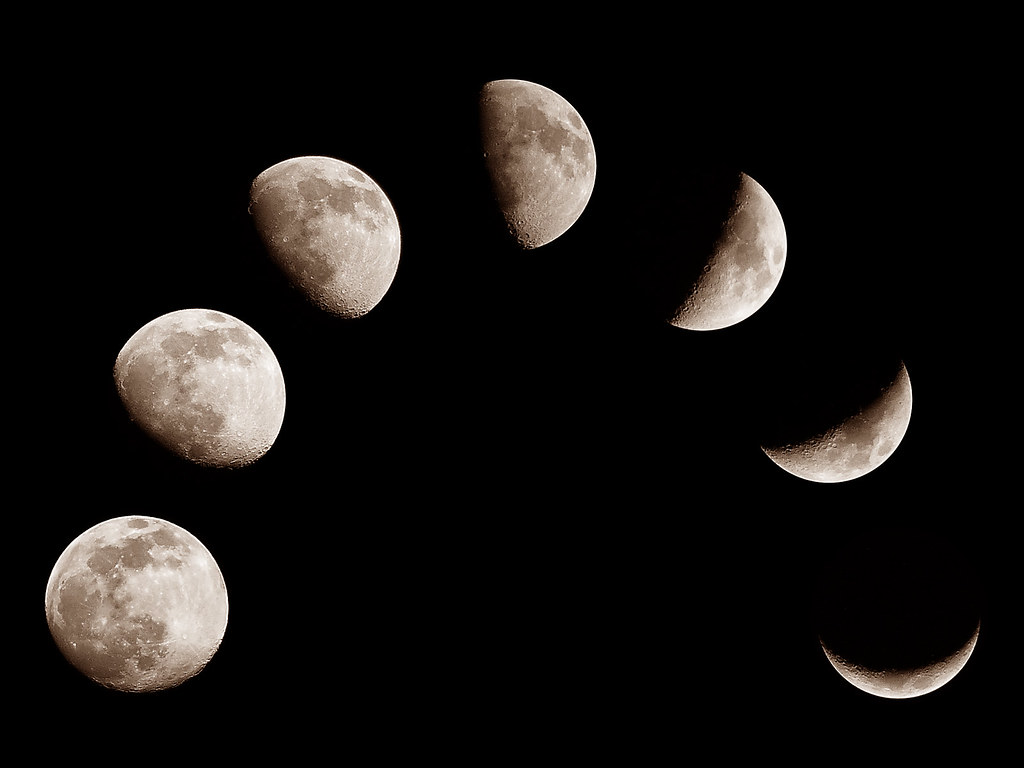



































In 1969, NASA’s Apollo 11 mission touched down on the moon. Or so we thought. Since the success of The Artemis II, NASA’s most recent mission and the first deep-space mission in 50 years, the infamous Moon Landing Conspiracy has resurfaced. If we were able to visit the moon fifty years ago, why didn’t we go back sooner than 2026?
What exactly is The Moon Landing Conspiracy? According to Wikipedia, the theory claims that some or all parts of the Apollo 11 mission were staged by NASA. To some, that may seem like quite an ambitious claim, but to others its fact. True or not, both sides of the argument have their fair share of supporting evidence.
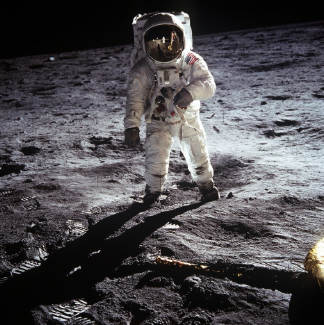
One piece of evidence: we have photos of the moon and astronauts on the moon. After observing the photos myself, I noticed a couple of strange details. For one, the quality of the photos doesn’t match that of photos taken by typical cameras in that decade. Late 1960s photos were extremely grainy and exposed, while the photos from the moon have less grain and exposure. Why? The answer is camera types. The cameras that NASA used in 1969 were modified Hasselblad 500EL Electric Cameras. Not exactly what you’d find at a local Walmart. The cameras were modified to be lighter and easier to carry. Quality wasn’t an issue; Hasselblads were some of the highest-quality cameras you could find in the 60s.
While this does clarify the quality difference, it doesn’t account for why no stars can be seen in the photos. Most people would consider this a closed case after learning that defining factor. No stars? Boom. Faked. However, there is a simple scientific explanation as to why. The photos were taken in broad daylight. Just like how you can’t see stars during the day here on Earth, you can’t see any on the moon if it is facing the Sun. Plus, high-exposure cameras definitely don’t help.
Nevertheless, photos can be fabricated. In 2024, a movie titled Fly Me to the Moon was released. The movie was labeled as fictitious, and the plot follows NASA as they fail to meet JFK’s deadline back in 1969, so they hire a Hollywood studio to assist them in staging the Moonwalk of the Apollo 11 mission. Certainly not an unheard-of idea. Media like this suggests that space simulators like Parabolic Flight (used to train astronauts to adapt to zero gravity) could have easily been used to recreate the effects that gravity has in space.
Many forms of media have proved that it was possible that NASA could have staged the Moon Landing, and exactly how they would’ve done it.
It’s not that unbelievable to think that the government would lie or confuse the public to convince and gain their favor. They’ve done it before. In 1964, during the Vietnam War, there was the Tonkin Incident. In 1991, during the Gulf War, there was the Nayirah Testimony. In 2023, during the Iran War, there were exaggerated threats to justify bombing. And in February of this year, our government made up threats that Iran had allegedly sent to justify bombing their country, again.
These incidents have a common theme- they’re all politically driven. It makes sense that the U.S.A would claim to have won the Space Race if it meant asserting dominance over Russia and ending the Cold War.
I guess the main question is why we haven’t gone back sooner. Contrary to common belief, we actually have gone to the moon between the launch of Apollo 11 and Artemis II. While not all were successful, the majority touched down on the moon again. For example, the Apollo 15 in 1971.
One thing is for sure: the reason we haven’t gone back to the moon in 53 years definitely isn’t the money. The cost of sending astronauts to the moon is roughly 150 billion dollars. Seems like a lot, but to put it into perspective, the U.S has spent 40 billion dollars on the I.C.E security force, 93.4 billion dollars on a furniture shopping spree for the Pentagon, 600 billion dollars invested in A.I development, and a whopping 961.6 billion dollars on defense alone. The claim that ‘we didn’t have enough money’ clearly doesn’t work as a cogent argument.
The Moon Landing is an interesting representation of the public’s relationship with the government. Despite scientists and government officials providing alleged evidence, people still suspect ulterior motives and fabricated stories. Whether the Moon Landing was faked or not, it’s fascinating to observe the social, political, and scientific impacts it had on the world back then, and to this day.